5 June 2026,
Friday

5 June 2026,
Friday
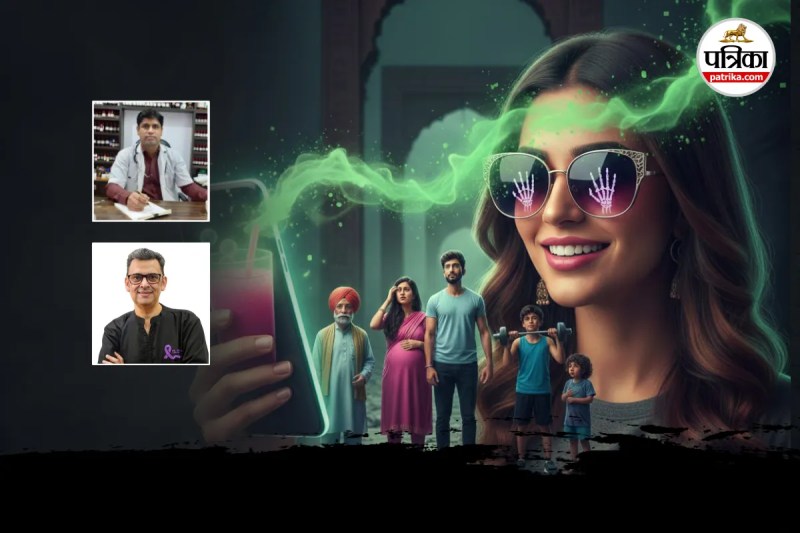
"Eat this and you'll never get cancer, these things prevent heart attacks..." There are countless videos on social media platforms like Instagram and Facebook that guarantee to cure diseases. Recently, a news report emerged about a 17-year-old youth in Moscow, Russia, who was so influenced by an internet video that he started drawing his own blood and drinking it. Several such cases are also seen in India. This presents a new challenge for the health sector and a risk for the public. Let's understand how health influencers are actually harming your health.
Consider the Moscow incident. It is reported that the young man was drinking his own blood to increase blood count in his body. His condition became so critical that he started vomiting blood. He has now been admitted to the hospital, where he is undergoing treatment.
Besides social media, people have now started seeking treatment from AI. A report by OpenAI states that approximately 40 million users per week are using this AI chatbot for medical and health-related information. This illustrates how eager people are to receive online medical advice.
According to a news report in The Times of India, a 60-year-old man in New York asked ChatGPT how to remove salt, or sodium chloride, from his food. ChatGPT advised him to use sodium bromide. To your surprise, this was used in medicines in the early 20th century, but is now considered 'toxic'. However, due to incomplete information, he started using it and was later admitted to the hospital.
These two cases alone demonstrate how dangerous this can be!
A study published on the National Library of Medicine, based on in-depth interviews with 12 health experts, assessed whether health influencer advice is accurate and what its potential impact could be.
The research highlights that there are two types of health influencers on social media: doctors or health experts, and general health influencers (who lack any degrees). It explains: One day, Maya posted a video: "Friends, I have stopped my medicines and now I only drink this special herbal decoction. I am cured! #NaturalHealing".
Although Maya's intentions were not bad, she did not realise that her experience was 'over-generalised'. That is, what worked for her could potentially be fatal for thousands of other sick individuals.
On the other hand, there was Dr. Sameer, an experienced physician who had recently created his social media account. He was concerned when patients visited his clinic and said, "Doctor, an influencer on the internet said that this medicine is not needed."
The story took a turn when one of Maya's followers worsened their health after drinking the decoction and ended up at Dr. Sameer's clinic. Dr. Sameer realised it was not the time to remain silent. Instead of 'debunking' Maya's video, he chose the path of 'educational collaboration'.
Dr. Sameer created a video in which he stated, "Maya's experience might be right for her, but science says every body is different. Changing treatment without medical advice is akin to spreading 'misinformation'."
Here, you can understand that following any kind of medical advice obtained online is dangerous, regardless of who is providing the information.
Dr. Jaish Sharma (Cancer Surgeon) says, "One can find many self-proclaimed experts on cancer on the internet. In reality, these health influencers are no less than a virus; they are increasingly dominating patients' minds. Patients also question us about these influencers after coming to us. Therefore, I myself am now working to spread awareness on social media about health misinformation. A concrete policy should be introduced for this. If they are not stopped, it could lead to a major problem in the future."
Dr. Manish Arora (Homeopathic) stated, "Influencers on social media also make various guarantees regarding homeopathic medicines. In fact, taking these medicines based on their advice can be life-threatening. Many patients make themselves sicker in this pursuit and then come to us for treatment."
Regarding a solution, both doctors are of the opinion that along with a strong government policy, we need to be aware of ourselves. You may gather information from AI, Google, or social media for your knowledge, but the final decision should only be made after consulting a doctor.








No comments yet.
Be the first to comment.